
You’ve spent years (maybe a decade, maybe longer) building itineraries that wow people. You know which camp in the Okavango has the guide who can track a leopard through a mopane thicket at dusk. You know that the September migration crossing at Kogatende is worth the bumpy charter flight, and that the “luxury” lodge your competitor keeps pushing has had water pressure issues since 2022. You know which DMC actually picks up the phone when things go sideways, and which one ghosts you until the crisis has passed.
You are, in every meaningful sense, already running a safari business. You’re just doing it for someone else.
And somewhere in the back of your mind — maybe on a long flight home from a familiarisation trip, maybe after watching your employer take the lion’s share of a booking you spent forty hours perfecting — you’ve thought about doing this for yourself. Building something of your own. Working with the clients who already trust you, not the brand on the letterhead.
Then you opened a spreadsheet, started listing everything you’d need to start your own safari business, and quietly closed your laptop.
If this sounds like you, then keep reading.
What actually holds most people back
Let’s be honest about what keeps experienced safari specialists from making the leap. It’s not a lack of ambition or talent. The people we’re talking about are among the most skilled travel professionals on the planet — crafting multi-country, multi-week itineraries across some of the most logistically complex destinations in the world.
The fear isn’t about whether they can sell safaris. It’s about everything else.
It’s the paperwork. The liability insurance. The trust accounts and client money regulations. The payment processing across multiple currencies and time zones. It’s the question of how you actually collect a deposit from a client in Connecticut for a lodge in the Kruger that invoices in South African Rand through a DMC in Cape Town. It’s the nagging worry that you’ll spend more time wrestling with invoices and compliance than doing the thing you’re actually brilliant at.
And underneath all of that, there’s the most human fear of all: giving up a salary. Even one that doesn’t remotely reflect your value.
These fears are rational. But they’re also solvable.
The industry has shifted
The travel advisory profession has gone independent. The majority of travel advisors now work for themselves as independent consultants, sole traders, and small business owners.
The reasons are straightforward. Clients don’t book with brands; they book with people. Especially in luxury safari, where the complexity of the product and the stakes of getting it wrong are both sky-high. Your clients chose you because of your knowledge, your honesty, your ability to steer them away from the overhyped and toward the extraordinary. That relationship is yours. It follows you, not the company logo.
And the market itself is booming. Africa recorded the highest tourism growth of any continent in early 2025. The luxury safari segment is expanding at nearly 8% annually. High-value bookings above $50,000 are up dramatically year on year. Demand for bespoke, expert-curated safari experiences has never been stronger, and that demand specifically rewards the kind of deep, specialist knowledge that only comes from years of doing this work.
What starting your own safari business actually looks like
The romanticised version involves a home office with a view, a laptop, and a glass of something nice while you craft itineraries on your own terms. And honestly? That’s not far off. But the practical reality has some important nuances worth understanding.
Going independent doesn’t mean doing everything yourself. That’s the critical misconception that stops most people. You don’t need to become an expert in payment processing, liability insurance, regulatory compliance, and accounting software on top of being a safari specialist.
The smarter model — and the one that’s driving the current wave of specialists going solo — is to partner with a platform that handles the operational infrastructure while you focus entirely on what you do best: curating extraordinary journeys for your clients.
Think of it as the difference between opening a restaurant from scratch (finding premises, hiring staff, getting health inspections, buying kitchen equipment, setting up accounts with suppliers) versus walking into a fully equipped kitchen where someone else handles the rent, insurance, and food safety compliance, and you just cook.
In this model, you keep your own brand. You work with your own clients. You set your own prices. You choose which suppliers and DMCs to work with. But the machinery that makes a travel business actually function is handled for you. You get the freedom of running your own business without the crushing administrative overhead that has nothing to do with why you got into this industry in the first place.
How much can an independent safari specialist actually earn?
Let’s talk numbers, because the earning potential is the part of this story that most people dramatically underestimate.
As an employed safari consultant at a mid-to-large tour operator, you’re likely earning a base salary somewhere between £25,000 and £45,000 if you’re UK-based, or $45,000–$65,000 in the US, plus some form of commission or bonus tied to your bookings. It’s a structure that rewards hard work, to a point — but the reality is that you’re seeing a small slice of the margin on trips you’re largely responsible for creating. The operator takes the lion’s share because they carry the brand, the overheads, and the infrastructure. Fair enough. But it does mean that the £40,000 Botswana itinerary you poured fifty hours into might put a few hundred pounds in your pocket, while the business banks several thousand.
Now consider the independent model. A luxury safari for two typically runs $20,000–$60,000 or more. When you’re setting your own prices and keeping your own margin, a single booking can generate $3,000–$6,000 or more in revenue for your business.
Three to four solid luxury safari bookings per month — achievable for an established specialist with an existing client network — and you’re looking at a six-figure income.
The data bears this out. Full-time independent advisors specialising in luxury travel earn substantially more than their employed counterparts — in many cases, 50–60% more. Your income scales with your expertise, your reputation, and the relationships you’ve spent years building.
The fears, addressed honestly
“I’ll lose access to my suppliers and preferential rates.”
This is probably the most common concern, and it’s worth unpacking. Some of your supplier access does come through your employer’s volume and relationships. But here’s what’s also true: many of your best supplier relationships are personal. The lodge general manager who returns your WhatsApp within the hour does so because they trust you. Those relationships travel with you.
And when you partner with the right platform, you gain access to their established supplier network and preferential rates from day one — without needing years of volume to qualify. The best platforms also let you bring your own preferred partners, so you’re not forced to abandon relationships that work.
“I can’t handle the financial risk.”
This is the salary fear talking, and it deserves respect. But consider what you’re actually risking versus what you’re giving up. Many independent specialists build their business alongside their current role before making the full switch. Others negotiate a part-time or consulting arrangement during the transition. And the reality is that if you have even a modest existing client following, you’re not starting from zero.
The operational model matters here too. Working through a platform that handles client payments, manages the money flow between you and your suppliers, and provides the financial infrastructure means you’re not personally carrying the complexity and risk of multi-currency transactions, deposit management, and final payment reconciliation. That’s the operational risk that genuinely sinks new businesses, and it’s entirely outsourceable.
“The admin will eat me alive.”
If you were doing this completely alone — setting up your own payment gateway, arranging your own liability insurance, navigating seller-of-travel regulations, building your own booking technology, managing your own trust account — then yes, the admin would be formidable. But that’s not the proposition. The entire point of partnering with a platform is that the back-office complexity is handled. Your job is to do what you’ve always done: know your destinations, know your clients, and craft trips that exceed both their expectations and their imagination.
“I don’t have time to build a website, learn a CRM, figure out new software…”
Fair concern. And it brings us to a point worth making: the technology you use matters enormously. The difference between itinerary-building software designed for generic travel and software built specifically for complex, multi-destination trips is the difference between a tool that slows you down and one that makes you faster than you’ve ever been.
The best platforms in this space let you build a fully priced, visually stunning itinerary proposal — with live availability, dynamic pricing, and professional presentation — in a fraction of the time it takes with a cobbled-together stack of spreadsheets, PDFs, and Word documents. For a safari specialist building a two-week, three-country circuit with seasonal rate variations across eight different properties, that time saving isn’t marginal. It’s the difference between spending your evening on admin and spending it with your family.
The specialists who’ve already made the leap
The safari industry is full of businesses that started exactly where you are now — small operations founded by experienced specialists who decided their knowledge deserved a business, not just a salary.
Some of the most respected names in the industry, the ones regularly featured in Travel + Leisure and Condé Nast Traveler’s top safari operator lists, started as one or two people with deep destination expertise and the conviction that they could do it better on their own. They didn’t have bigger marketing budgets or fancier offices than their former employers. They had specialist credibility, personal client relationships, and a willingness to bet on themselves. And crucially, they didn’t succeed by becoming generalists — they succeeded by going deeper into their specialism.
Ololo Safaris, for example, grew their revenue by 30% after streamlining their operations and itinerary process — proof that the right tools paired with specialist expertise create compounding returns.
You already have that knowledge. You’re generating it every day. The only question is who profits from it.
What to look for in a safari business platform
If the case for independence is compelling but the operational barriers feel daunting, the practical question becomes: what should you look for in a platform partner?
The non-negotiables are clear. You need professional liability insurance handled. You need payment processing that manages the complexity of multi-currency safari transactions — deposits, balance payments, supplier disbursements — without you becoming an amateur accountant. You need regulatory compliance sorted. And you need technology that’s built for the specific complexity of what you do.
Beyond the basics, look for a platform that lets you set your own prices and maintain your own margins. Look for one that gives you access to strong supplier networks while also letting you work with your own preferred partners. And look for one that understands safari specifically: seasonal pricing, live lodge availability, multi-stop itinerary logistics, and the kind of beautiful, detailed trip presentations that convert high-value clients.
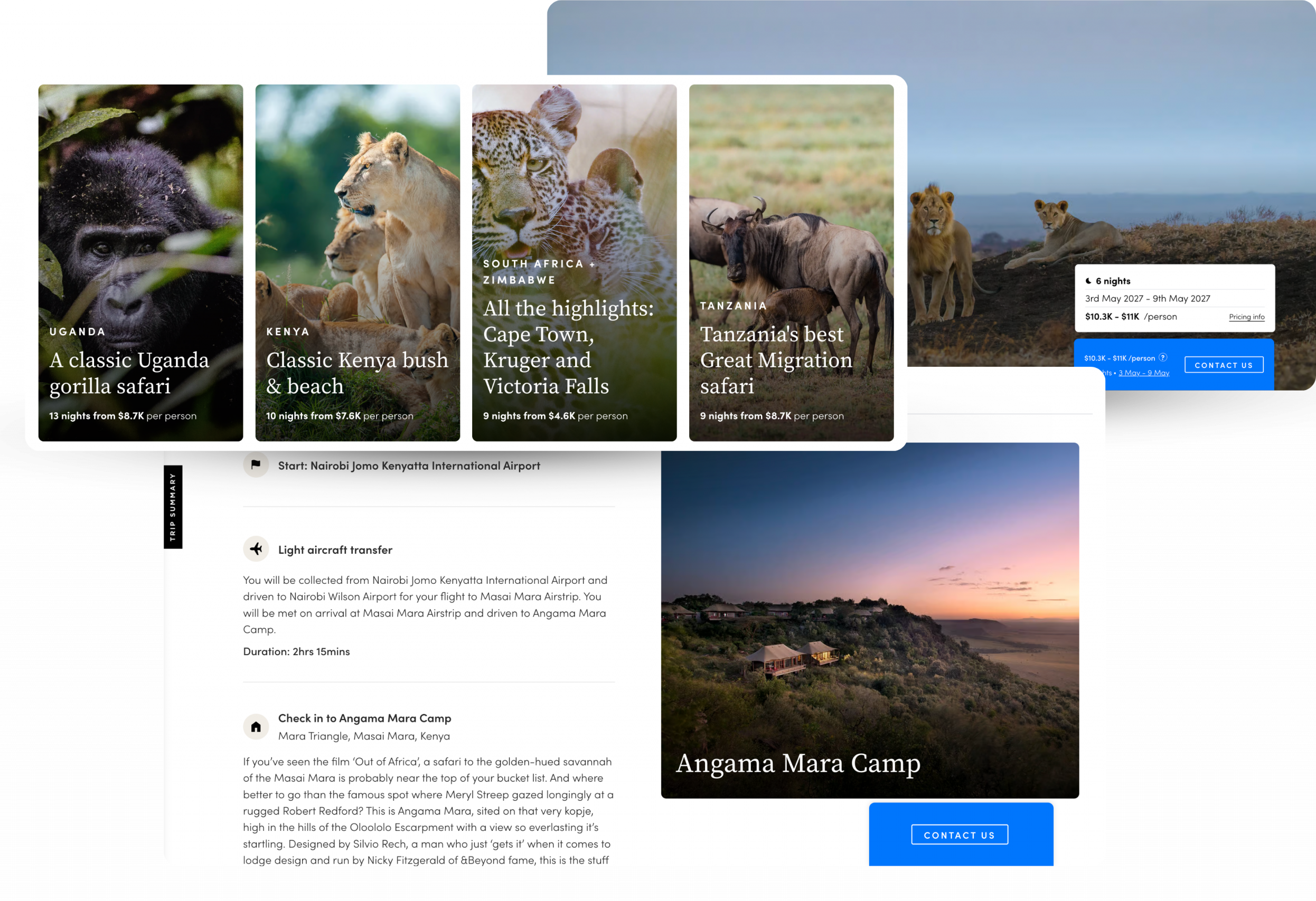
Waybird was built for exactly this. Created by the team behind Timbuktu Travel — named the World’s No. 1 Tour Operator by Travel + Leisure — it’s a platform designed from the ground up for specialists crafting bespoke, multi-destination journeys across Africa, Asia, and Latin America. Its library of thousands of curated properties with live availability integrations, combined with itinerary-building tools specifically designed for complex routing, means you can produce professional, fully priced proposals in minutes rather than hours. And its hosted model handles the operational infrastructure through an 80/20 profit-sharing structure where you retain control of your pricing, your brand, and your client relationships.
It’s not the only option. But it’s worth understanding what was purpose-built for safari specialists versus what was adapted from something else.
The window is open
The structural forces in the travel industry right now — the shift toward independent advisors, the growing demand for bespoke luxury experiences, the technology that’s eliminated operational barriers, and clients’ overwhelming preference for individual expertise over corporate brands — have created an environment that specifically rewards experienced safari specialists willing to back themselves.
The greater risk may not be leaving. It may be staying — watching your expertise generate margins you don’t share in, building client loyalty for a brand you don’t own, and deferring a decision you already know the answer to.
You’ve been running a safari business for years. It’s time it was yours.
If you’d like to explore what going independent with Waybird looks like, get in touch — it was built for people exactly like you.
